Tuesday, April 23, 2013

Call to Action: Free Oscar López Rivera


by Xavier "Xavi" Luis Burgos

Any student of history could and should be able to communicate that what is placed in one’s school books is far from objective. Historical events walk along the lines of power and influence. In our contemporary society, what is considered notable to tell future generations must reaffirm (and be repackaged to fit the) status quo, even if it appears to be one of dissent. That is why very few people in the United States know about Oscar López Rivera, a Puerto Rican political prisoner for the last 29 years.


There are very few people who could argue that Puerto Rico is not a colony of the United States. In a 1922 case, the U.S. Supreme Court ruled that the island belongs to but is not a part of the Union. Moreover, the U.S. Congress (which only has one non-voting representative from Puerto Rico) can exercise full powers over the possession, including overriding any laws adopted by the local legislative body. This, among other reasons, is why Oscar López Rivera, in the 1960s and 1970s, struggled for independence in a long trajectory of other movements and figures.

Born in San Sebastián, Puerto Rico on January 6, 1943, López Rivera was a part of the massive migration of islanders in the 1950s, and settled in Chicago. By the advent of the Vietnam War, he was drafted into the military and earned a Bronze Star for bravery. Like many other servicemen of color who returned to their communities, he witnessed extreme forms of poverty, substance abuse, and other manifestation of racism and inequality. This motivated López Rivera to organize other community activists and build institutions, initiatives, and programs that still exist today, like the Puerto Rican Cultural Center, Dr. Pedro Albizu Campos High School, and the Latino Cultural Center at the University of Illinois-Chicago. Furthermore, he advocated for fair housing, bilingual education, and an end to police brutality and racist practices in public utilities. Following the international spirit of the times, by the mid-1970s he joined a guerilla organization to step up the pressure on the U.S. government to address the colonial question of Puerto Rico.

By 1981, he and other alleged members of the organization were arrested for seditious conspiracy to overthrow the U.S. government in Puerto Rico and were sent to prison with disproportionate sentences. All but two of his compatriots were released by 1999 due to an international campaign that persuaded President Bill Clinton to offer them clemency. The remaining two were released on parole. Oscar López Rivera remains in prison despite, like his fellow prisoners, denying being a part of any acts that killed or injured anyone. More importantly, he was never charged with such actions.

What is interesting is the fact that many U.S. citizens are absent-minded about this country’s imperial history, while elevating towards sainthood those whose background are very similar to that of López Rivera. Nelson Mandela, the famed South African hero of racial equality, is a great example. In the early 1960s, Mandela was one of the founders and leaders of an armed guerilla group that took responsibility for multiple bombings on civilian and military installations, resulting in many deaths. He also spent 27 years as a political prisoner of the white, apartheid system that sought to destroy the spirit of the black indigenous population. Mandela was never charged with attacks on human lives, but with seditious conspiracy, just like López Rivera and his compatriots. Ironically enough, President Barack Obama is slated to write the forward of Mandela’s new book while ignoring the plight of his government’s own political prisoners and colonies. Therefore, it is safe to say that if anyone believes Nelson Mandela is a historic figure of great stature and justly represents global struggles of national liberation (which, he indeed, does!), then Oscar López Rivera should also be out of prison.

On January 5, the U.S. Parole Commission hearing examiner, Mark Tanner, recommended to the parole board that López Rivera serve his full sentence (slated for 2023) or serve another 15 years before being released. This was done despite the fact that thousands of people signed petitions asking for his release, including three Congress people, the Archbishop of Puerto Rico, the Resident Commissioner of the island (who does not believe in independence, but in statehood!), and numerous elected officials in Chicago, Philadelphia, New York City, and even Haiti. In an act that uncovers the political nature of López Rivera’s case, the parole board never responded to the Puerto Rican Bar Association’s request to be at the hearings, but victims of the bombings that López Rivera was never charged with conducting, were allowed to testify – unbeknownst to his own lawyer until the day of.

Nonetheless, the parole board still needs to make a final decision and could do so as early as February 1. The National Boricua Human Rights Campaign is asking for petition signatures and phone calls to the U.S. Parole Commission everyday, between 9-5pm at (301) 492-5990. Everyone’s voice can be influential.

Originally published at Gozamos.com on January 31, 2011. 

Friday, June 15, 2012

Building an Open, but Affirming Community


by Xavier “Xavi” Luis Burgos


The steel flag monuments on Paseo Boricua are the ultimate representation of a conscientious affirmation of our people’s existence, an assertion of our greatness, and a proclamation of an incredible vision of the future. This is not to say that they are barbed wire fences of exclusion. On the contrary, they are welcoming gates to all those who want to learn and be a part of what we hope to develop: a Mecca of the Puerto Rican Diaspora, a cultural and economic corridor on par with any Chinatown, Little Italy, or Mexican enclave.

But to the mainstream media, real estate developers, and I dare say new (mostly white) residents, our community is a barren wilderness; dangerous, obscure, and in need of bulldozing. If not that, Humboldt Park for such folks is an exotic locale, a safari of sorts, to gawk at and revel in its primitivity. This is the discourse of gentrification, the manifestation of long-time resident displacement - it is imposing, exclusionary, and in complete disregard of our history and heritage.

I provide you two examples. The first is the so-called “Riot Fest,” a punk rock festival to take place in Humboldt Park at the end of the summer. Did the organizers consult with the multiple age-old institutions and organizations to see if the community would welcome them? No. Did they speak with the residents of the elderly homes that are across the street where their stages and a possible beer garden will be set-up? No. The lack of communication between the festival’s organizers and the very community of its location is telling of the inconsideration and imposing nature of gentrification. Even more telling is the fact that not one Puerto Rican rockero group is on their line-up and that they will be charging up to $155 for tickets. It is as if this event is not for us to attend.

The second is a community meeting organized by Casa Puertorriqueña last week stormed by two pro-gentrification groups influential in campaigns against affordable housing. They dominated the discussion, made unrealistic and resource-draining demands, and spoke without an ounce of modesty. One of their spokespersons even had the gall to claim that they were the community despite the fact they had only lived here for a couple of years.

We are a community that is open, yes, but any lack of humility and respect - inherent in a true dialogue - on the part of new residents will always be met with opposition. This is what centuries of colonialism has taught the Puerto Rican. The table is open and set for discussion, but it must in the spirit of collaboration with an already established plan of this community’s future.


Originally published in La Voz del Paseo Boricua newspaper, June 2012 edition


Tuesday, May 8, 2012

Boricuascape


By  


I
My great-grandfather, Marcos Burgos Santiago, died at the age of ninety-nine. His funeral, as my cousin Denise recalled, was larger than life. It seemed as if the entire town came to pay their respects to the oldest man they knew. He had never lived anywhere else but in Juncos, Puerto Rico, in the same barrio, just like his parents before him. His house, once made up of dirt floors and a tin roof, now serves a new generation of family residing comfortably behind concrete walls. I remember still how he would show me, with pride, a missing part of his finger, chopped off from a machete while he worked harvesting sugarcane. In a way, he was showcasing how much the land was bounded to him and the extent to which it left its mark.
Though he lived what many would call a long and full life, one thing haunts me. Born at the turn of the 20th century, Don Marcos resided completely under the rule of the United States. Almost one hundred years of life, and he never knew what it meant to live in freedom. He knew love, being married to my great-grandmother for nearly seventy years. He knew pain, having comforted his six-year-old daughter, as she lay on her death bed, waiting for his return from the fields so as to pass finally into oblivion. But not freedom. Even worse, nor did his parents, who lived under Spanish rule, or their parents before them. Five-hundred-years have passed, and Puerto Rico remains a colony, property of another country with a government that does not nor is expected to have our interests or our feelings in mind. Even the most ardent pro-statehooder acknowledges this. The same for some populares, if you catch them in a bar on a warm Saturday evening. Five. Hundred. Years.
There was more for Don Marcos to care about, of course, than some nebulous and abstract concepts like freedom, self-determination, and a representative democracy that shares a stage among a league of nations. He had to feed his family (made increasingly difficult by the guzzling-up of arable land by corporate greed that transformed the island into a sugar monopoly). He had to ensure a formal education for his children (who were taught that Spanish was a primitive language and that their forefather was George Washington). His severed finger was a life-long indicator of his endurance and hard-work. But such a scar dug deeper than it appeared to. It cloaked the entire island. The ugly and disgusting scar of colonialism.
Like millions of others, Don Marcos’ son left the barrio for the fields of New Jersey and then to the decaying Chicago metropolis, to make a new life with his wife and children. None ever returned to live among the yellow flamboyant trees and probably never will. But we should shed no more tears. Although the island is of a far spatial and temporal distance, it is an undeniable spiritual center of our existence. Our beloved Zion. However, we have not only extended the boundaries of an ethno-cultural nation located on the island, but in some ways, constructed a parallel national experience. It is too difficult for those, like Don Marcos, who never left, to fully and deeply connect with the poetry of Pedro Pietri, or the prose of Nicholasa Mohr, or some of the plays of Jose Rivera. We are diaspora people with our own distinctiveness. More importantly, we inhabit lands that we call our own.
II
A little over a month ago, I asked a close friend to explore with me the Puerto Rican communities of Williamsburg and Bushwick in Brooklyn, places like El Barrio in Manhattan, where her own grandparents migrated to. As we traveled through locations with street signs marking “Avenue of Puerto Rico” and “Borinquen Place,” we soon realized that the eroding murals depicting urban jibaros and palm trees spoke to a Golden Age long dislodged from reality. With the exception of a few cars blasting reggaeton and rows of housing projects that reflect our state-sponsored ghettoization, this side of Brooklyn was visibly absent of a once bustling Puerto Rican enclave. Although the street was teeming with young, white “hipsters” visiting store-front art galleries, it was as if we were metaphysically stranded in a desert. The life we were seeking did not exist but in our memories, so nothing around us stimulated our senses. We longed for a place we could call home.
Mari and I both have homes, though, and in historic Puerto Rican communities too; the South Bronx and Humboldt Park, respectively. Just as my family could travel outside of their small town and experience the landscape of their nation, the possibility also exists in the diaspora. Similar to the Black, Chicana/o, and Native American experiences, while we have settled in clusters in diverse and disparate areas throughout the U.S., we have an opportunity to witness our communities and to share our histories and struggles. This is how we develop(ed) a collective identity and potentially find a forum from which we seek solutions to our ills. Moreover, such a dynamic expands the “va y ven” paradigm that conceptualizes a multi-linear route between U.S. cities and towns towards and from the island. I propose to you that there simultaneously exists, especially in settlement and occupation patterns, a movement between the diaspora enclaves. Unfortunately, not so much in terms of dialogue and community-building efforts.
Many times we speak of “our people” as some amorphous tangled body living in the air. Though we are not all inhabiting rigid geographic areas, there are numerous locations, such as in Newark, Orlando, Philadelphia, and Chicago, where we have constructed community for generations; where our artistic and political expressions have blossomed. The areas, oftentimes left to us in disarray, have also been loci of a decolonization process, because in them we have exhibited what was denied to us on the island, denied from Don Marcos: self-determination. But colonialism stalks us wherever we lay our feet, this time in the form of gentrification that rips away the freedom for self-definition and self-reliance. We must begin then to imagine ourselves as conducting a distinct national experience rooted, like my great-grandfather’s hands, in land. Subsequently, we will realize our immense responsibility to each other in composing a country-wide challenge to the most alarming and destructive force facing us today. In other words, displacement in Graham Avenue in Bushwhick should be just as important to Clark Avenue in Cleveland or Park Street in Hartford, because they all inhabit a vast Boricuascape. Without such a vision and action-plan, our descendants too may lament over a burden that should have been kept from them long ago.
Originally published in the February 2012 editions of La Voz del Paseo Boricua and Gozamos. 

Behold, The Boricua Diaspora


Envision, for a moment, a soundless and barren urban landscape, encroached on by a harrowing, opaque sky and bright, white snow mystically descending from the heavens, with only dim street lights to guide a path. Your awe-struck eyes gaze upon the overwhelming swarm of small, cold particles engulfing the air, swirling with the wind in a synchronized, rhythmic movement, rapidly melting on sun-burnt skin. Finally, your mind collides with the cognizance that this shall be the eternal home of lineages unrealized and that Puerto Rico is a land of no return. What a sorrowful and beautiful genesis to a narrative laid before us; the setting of the stage of an epic and incomparable tale of tragedy and greatness unforeseen.
Such was the experience of thousands of pioneras/os, like my grandmother, who endured a particular migration decades ago; there were many before and many after them. In whatever time we locate the conception of a diaspora that owes its existence to a U.S. government-sponsored colonial enterprise, we must descry the fact that subsequent generations, physically distant from the island, continue to identify as Boricua. Some merely say that one can still be Puerto Rican even if residing outside Puerto Rico, as if the island is lending us magical keys to a locket of authenticity. In many ways, to be Puerto Rican is to be a part of our diaspora. In other words, there is a distinctive Puerto Ricanness in the U.S. and the island is just one (important) piece in a complex and colorful mosaic of cultural ruptures and innovations.
No matter if God decides to rid our little chaotic island
from its uncertain misery
and sends a wave of destruction
from the very waters that brought us our oppressive history
and sinks Borinquen to the water’s floor
our story will be narrated by the jíbaros on the moon
Unfortunately, our communities are burdened with institutions, artisans, and educators who make it a point to extract the political from the cultural. Puerto Rican cultural consciousness is inextricable from the political. When the dwellers of the island and the diaspora began to understand themselves and their cultural productions as distinctively, unmistakably, and uniquely Boricua, they simultaneously understood, due to a subordinate sociopolitical status, the danger in making such claims. In essence, Puerto Rican culture and identity is a product of resistance. Thus, to be proudly Boricua, is to be solemnly defiant. To affirm apuertorriqueñidad is to thwart the processes that seek our destruction. But, many of our institutions, artisans, and educators present the world with sanitized, nostalgic, and island-centered artistic representations detached from our lived experience in the U.S. Most, but not all, contemporary art by the Puerto Rican Diaspora is thus without purpose or direction.
Yes, there are many possible routes and trajectories, but one thing must be clear: there needs to be a aesthetic attached to an ongoing process to cultivate a non-assimilationist, diaspora-specific, solution-proposing, and culturally affirming agenda. In order for it to be meaningful, this aesthetic, utilizing photography, painting, literature, poetry, film, theater, sculpture, music, dance, and song, must be by and for our people and rooted in our communities (both historic and new).
If we construct a New Boricua Diaspora aesthetic we can, with greater clarity, understand who we are and map out possible directions. Quite simply and unequivocally, we can begin to recognize and honor our beauty, particularities, and greatness and heal wounds of self-hate and cynicism. This, for what it is worth, is an invitation to dialogue and to create. Who shall heed the call? Whose art will proclaim, “Behold, the Boricua Diaspora, in all its lamentations, in all its glory”?
Originally published in La Voz del Paseo Boricua and Gozamos, November 2011

A Decaying Boricua Diaspora


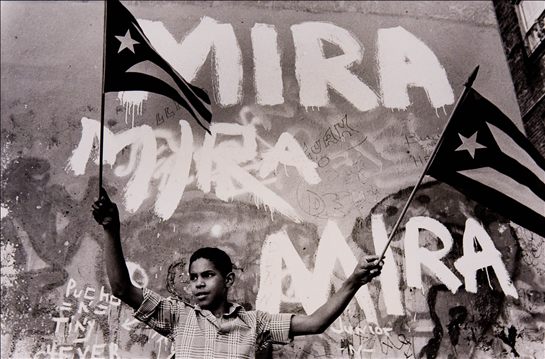
Feature photo by Geno Rodriguez
We are from “allá afuera.” As such, we inhabit a nebulous and intangible world in the imagination of those who have not trekked beyond their Caribbean waters (and in even those who have). It is as if, in the insular colonial imagery, we dwell upon the heavens, sitting on top fragile clouds or lurking behind the stars, out of touch with humanity. But celestial beings we are not. Our existence, on Earth, is obscured. We are deemed a throw-away people, cultural pollutants, who were never suppose to return, never to witness the island of our forebearers. “Tú no eres Boricua” can be the most spiteful slander an islander can bestow upon us, not so much because of an innate insecurity, but the acknowledgment of our difference.
“i want to go back to puerto rico,
but i wonder if my kink could live
in ponce, mayagüez and carolina” (Tato Laviera)
According to the 2010 United States census, there are, for the first time in our history, more Puerto Ricans living in the U.S. than on the island; 4.6 million to 3.7 million to be exact. As time continues, less and less the children of Borinquen reside on our tragic Eden, despite the conviction that it remains our communal ‘home.’ The question why is important, but what characterizes our exiled existence as a hint to new collective directions is even more intriguing.
As stated by Boricua theorist Juan Flores, the root definition of Diaspora means a “scattering or of sowing seeds (-sperien) across space (dia-)”, a suitable metaphor for the construction of Puerto Rican enclaves; from a minute bud to a growing vine germinating nuances in identity and community-building. For Flores, a Diaspora is not just about people moving to a new place, but the unraveling of a consciousness about the place they are in and the place they left. In the aftermath of the first Great Migration of the late 1940s to early 1960s, we forged emblems of our “inherited cultural backgrounds” in institutions, cultural festivities, literature, music, and political organizations, but with a palette of distinct “ruptures and innovations” detailing, exalting, and even lamenting our cultural aberration from those on the island. Like that of nations, our community is imagined, because although we could never know all the members of such a disparate Diaspora, it is a communion in which our connection is internally recognized and a camaraderie eternally yearned for.
With controversial origins and often critiqued markers like ‘Chi-Rican’ or ‘Nuyorican’, we are united by a reference point and a new location, but of also disturbing social ills. As an au courant exodus out of our island unfolds before our tired eyes, we continue to face high levels of poverty and low levels of formal education, exacerbated by the destruction and displacement of our historic centers and a psyche of inferiority. Moreover, the cultural and political institutions we have created throughout the decades are decaying because there are those among us who submit to the pressure to homogenize our experiences and unique historical memories under a “latino umbrella” and thus render any affirmed puertorriqueñidad as taboo and separatist. And even worse, those of us who obtain any sort of money or education, leave our life-centers, detach and disassociate themselves from ‘those in the ghetto’ and produce offspring with a sort of Du Boisian triple-consciousness – never accepted by a racist world and never truly accepted by one’s own people on both sides of the Atlantic. We are here, but less cohesive and pronounced, persistently misrepresented and misunderstood by the islander, the greater U.S. society, and by some in our flock.
The leaking faucet of our tropical kin continues to flow and detrimental social forces endure in a masquerade around our unmarked tombstones. We are at the crossroads of possibilities stretching from a path of great historical and resilient contemporary feats, but jointly, across the cities and towns of our presence, something is lacking, the earth-shattering urgency remains nonexistent. With the effort of producing and amplifying safe spaces of in-depth dialogue on such socio-political conundrums and subsequently courses of direct action, can we approach the horizon with a profoundly inspiring, renewed, and reinvigorated vision for our people in the Diaspora. But the challenge has so few recruits while any semblance of our existence continues to erode. We are full of possibilities, but in a deep slumber we continue to lay.
Originally published on Gozamos and La Voz del Paseo Boricua in August 2011, and Claridad de Puerto Rico in February 2012

References:
1. Laviera, Tato. (1992). my graduation speech. la carreta made a u-turn (pp. 17). Houston: Arte Público Press.
2. United States Census Bureau. (May 26, 2011). 2010 Census Shows Nation's Hispanic Population Grew Four Times Faster Than Total U.S. Population. Retrieved from http://2010.census.gov/news/releases/operations/cb11-cn146.html
3. Flores, Juan. (2009). The Diaspora Strikes Back: Caribeño Tales of Learning and Turning (pp. 16-17). New York: Taylor & Francis Group.
5. Anderson, Benedict (2006). Imagined Communities. New York: Verso.
6. Du Bois. W.E.B. (1903). Of Our Spiritual Strivings. In The Souls of Black Folk. The Health Anthology of American Literature: Volume D Modern Period 1910-1945 (pp. 897-902). Boston: Houghton Mifflin Company.